

A few weeks ago, I was invited to speak on a panel about ‘what being Gujarati means today’, organised by the Gujarati Sahitya Akademi in the UK.
At first, I struggled with whether I was even ‘Gujarati enough’ to be there. I have had this deep-rooted insecurity for much of my life: I am not ‘Gujarati enough’ and not ‘Malayali enough’ either. And then I wondered: the other two panelists were veteran journalists, editors and publishers; what could I possibly have to offer?
Thankfully, I spoke to some of my lovely friends, who reminded me of something golden: I didn’t need to represent every Gujarati. I could simply represent my version of being Gujarati. That gave me the confidence to stop worrying whether I qualified and start thinking about what I could contribute.
Who is a Gujarati? The answer is far more complicated than I thought. I grew up in Maninagar, Ahmedabad. My grandparents had moved to Gujarat from Kerala, so technically, I am Malayali too. However, in the past few years of living in the UK, if someone asks me, “Where are you from?”, I almost instinctively say, “Gujarat.” I had to accept this pleasant contradiction.
The first time I started questioning this identity, I was in college. I had heard the word ‘ghetto’ for the first time and it was in a documentary screening about America. I had learned that a ghetto wasn’t simply an area where a particular community happened to live in large numbers. But it was also separate from the rest of the city, physically, socially, and economically.
And then it occurred to me: We have these in Ahmedabad too. Suddenly, places I had always heard of but never been to began looking different to me.
For example, Juhapura, which is the greatest concentration area of Muslims in Ahmedabad. An alternate name that it got after 2002 (riots) was ‘Mini Pakistan’. And so when I first visited a local community in the area, as a part of my volunteering work, I was genuinely expecting guns and anti-social behaviour. I was only 19, so (obviously) I did not tell my parents I was going.
To my surprise (and now worth a joke), there were no guns or knives there. Juhapura looked like any other area, with some parts poorer than others. There were people who looked like me. People who spoke like my friends. Families, shops, children, flats. And there were children who simply wanted to learn to speak English.
Eventually, we began teaching there. The community gave us a space that was used as a madrasa in the mornings and evenings. And so, along with my friends, I kept going back.
And slowly, I realized something: the Gujarat I knew was not the only Gujarat. This experience made me question everything about whatever we were told about ‘these areas’, ‘these people’. Instead of asking What are Gujaratis like?, I started asking: Whose Gujarat are we talking about? Because where you stand in Gujarat changes the answer.
As an adult in Gujarat, I saw two primary aspects to being a Gujarati:
One is our extraordinary focus on getting ahead. We are very good at asking, How do I move forward? On the road, in a job, in business, in life. But we don’t question collective progress. Education, public infrastructure, quality of life, employment, governance, civic sense; these things seem strangely off-limits in public conversation.
The second is our complicated relationship with purity, particularly around food, caste and community. I grew up around the idea that being vegetarian wasn’t simply a dietary choice. It could become a symbol of morality and respectability.
For example, my mother has friends she has known for 25 years who still don’t know that we are not vegetarians. Eggs or meat would arrive at home wrapped in a black polythene bag.
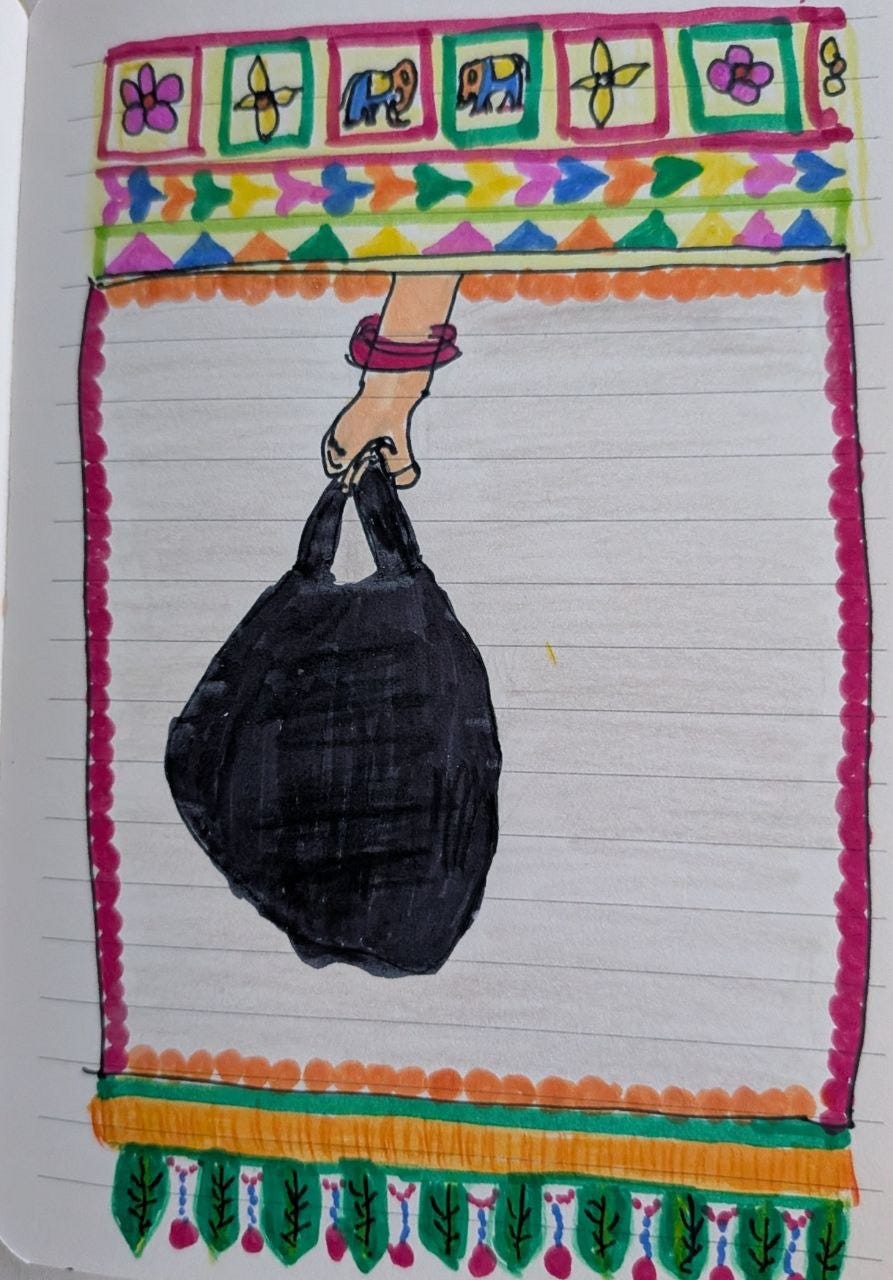
I find that fascinating, not because of what we eat, but because of the fear we carry about people’s reaction. It is no coincidence that another thing used to arrive in a black polythene bag too: my sanitary pads.
I used to find that funny. The black polythene bag seemed to represent so many things we were ashamed of, or simply didn’t want other people to see.
Sometimes food is just food. And then other times it carries the eseence of caste, religion and purity with it.
And yet, somewhere along the way, I have also felt proud of being a Gujarati. Particularly after I left India.
There is something strange about leaving India. At home, you could be anything: a Gujarati, Malayali, Bengali, or a Punjabi. Abroad, you become Indian; and suddenly your regional identity can feel even more important.
When I first came to the UK as a Master’s student, two completely unrelated Gujarati families helped me.
One was a Hindu family living in a small town near London. People I had never met came to collect me from the airport, showed me how to navigate this strange new country, and let me stay with them for almost six weeks.
They gave me food, accommodation, and a place in their family. Eventually, I left only because I needed to move to London for my studies, not because they asked me to.
The other was a Muslim man living in London who had supported my best friend’s sister through a very difficult period. When I came to London as a student, he subsidised my rent and didn’t make me pay the electricity or water bills.
Whenever he met me, he wanted to speak Gujarati. He had left Gujarat 25 years earlier, but he still craved speaking his language, one that even his own children didn’t speak.
These were very different people, both deeply religious. They wouldn’t be found together in any common setting.
But they still had one thing in common: their principle of helping another Gujarati, or simply helping another person, felt like a responsibility to both of them.
That’s what Gujaratis do. That made me proud.
Which is why, when I look back at Gujarat today, I sometimes feel a sense of discomfort and grief.
I hear people from my own Gujarati community say they wouldn’t employ a Muslim person. I know doctors who privately don’t want to treat Muslim patients. Friends have asked me whether I feel safe living in London because the mayor is Muslim.
And I find myself thinking: when did we become so afraid of each other?
What happened to that instinct to help first and ask questions later?
The biggest change in my understanding of being Gujarati came from changing the position from which I looked at Gujarat.
I have now understood a few things about my experience of Gujarat. Although I didn't come from a Gujarati family, I grew up experiencing Gujarat largely from a position of belonging. Technically, I was Malayali, and being called ‘from South’ at Gujarati friends’ homes revealed my family’s origins. However, it still didn’t make me a minority because I was, in fact, an upper-caste Hindu.
Eventually, when I moved to London, I became part of a minority myself. It wasn’t always comfortable. There is no fun in being a minority.
Experiencing both sides doesn’t automatically make you connect the two. That’s the thing. Once you put the two experiences together, you can’t quite go back to seeing identity in the same way.
You notice who gets to feel at home, who gets to feel safe, and who may have to think about it every day.
So what does being Gujarati mean to me today?
I am immensely proud of our enterprise, our generosity, our ability to build networks across countries, and our instinct to support one another.
But I am also concerned about what we are becoming.
In my mind, being Gujarati doesn’t need to mean exceptionally successful, wealthy or influential. For me, it can mean something much simpler: being great human beings and citizens.
We point to our global success, our businesses, our politicians, our diaspora and our economic growth as evidence that everything must be working perfectly. Is it, though?
Sometimes our pride should not prevent self-criticism. If anything, belonging should give us the confidence to criticise ourselves.
I don’t want to inherit a Gujarati identity that is only about wealth, enterprise, vegetarianism, achievement or political pride.
I want to inherit the values of the Gujarati who builds something from very little. The Gujarati who opens their home to a stranger. The Gujarati who leaves Gujarat and creates a community wherever they go. And where people don’t need to hide behind a black polythene bag.